
Welcome to Lulua-Dubai Company
Discover Quality, Experience Excellence
Discover Quality, Experience Excellence
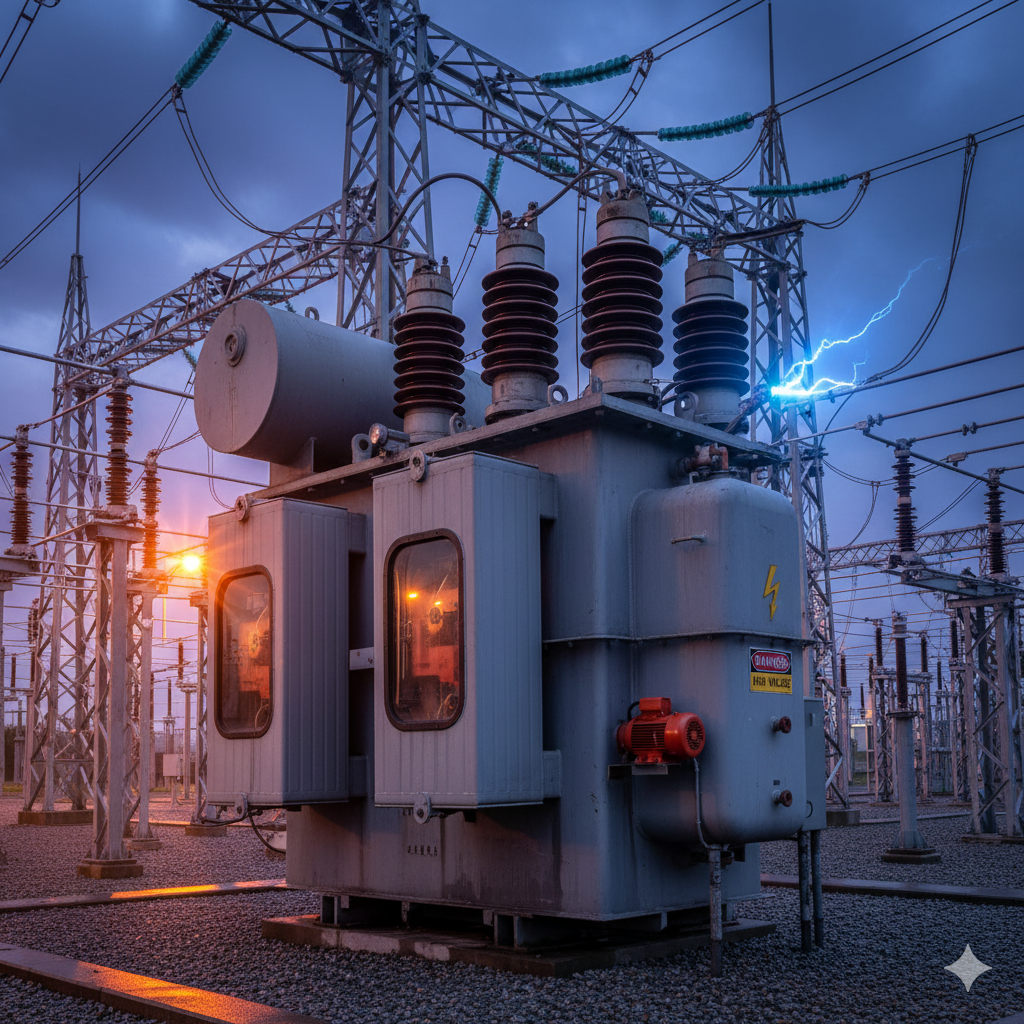
An electrical transformer is a static electrical device that transfers electrical energy between two or more circuits through electromagnetic induction. Its primary purpose is to change voltage levels, either stepping up (increasing) or stepping down (decreasing) alternating current (AC) voltages, while maintaining the same frequency. This fundamental ability makes transformers indispensable in the generation, transmission, and distribution of electrical power.
How a Transformer Works:
The operation of a transformer is based on Michael Faraday's law of electromagnetic induction. It consists of two or more coils of wire, called windings, wound around a common laminated soft iron core.
Primary Winding: This winding is connected to the AC input voltage. When an alternating current flows through the primary winding, it creates a continuously changing magnetic flux in the core.
Magnetic Core: The laminated soft iron core provides a low-reluctance path for the magnetic flux, efficiently coupling the flux between the primary and secondary windings. Lamination (thin sheets of iron separated by insulating material) is used to reduce eddy currents, which are circulating currents induced within the core itself that would otherwise lead to energy loss and heating.
Secondary Winding: The changing magnetic flux generated by the primary winding cuts through the turns of the secondary winding. According to Faraday's law, this induces an electromotive force (EMF) or voltage across the secondary winding.
The ratio of the number of turns in the primary winding (Np) to the number of turns in the secondary winding (Ns) determines the voltage transformation.
Step-Up Transformer: If Ns > Np, the secondary voltage will be higher than the primary voltage.
Step-Down Transformer: If Ns < Np, the secondary voltage will be lower than the primary voltage.
Importantly, while a transformer changes voltage and current levels, it does not change power (ideally). The power in the primary circuit is approximately equal to the power in the secondary circuit (minus some minor losses). Therefore, if voltage is stepped up, current is stepped down proportionally, and vice-versa.
Types of Transformers:
Transformers come in various designs and sizes, each suited for specific applications:
Power Transformers: Used in power generation stations and transmission substations to step up voltage for long-distance transmission and then step down for distribution.
Distribution Transformers: Located near consumers (on utility poles or in underground vaults) to step down high distribution voltages to lower voltages suitable for homes and businesses (e.g., 240V/120V).
Instrument Transformers: Include Current Transformers (CTs) and Potential Transformers (PTs), used to measure high voltages and currents safely and accurately in power systems.
Isolation Transformers: Provide electrical isolation between two circuits, often used for safety or to reduce noise.
Autotransformers: Have only one winding that acts as both primary and secondary, offering smaller size and lower cost but without electrical isolation.
Specialty Transformers: Such as multi-tap, variable, and pulse transformers for specific electronic applications.
Importance in Power Systems:
Transformers are crucial for the efficient transmission of electrical power. Generators produce electricity at moderate voltages, but transmitting this over long distances at low voltage would result in significant energy losses due to resistance in the transmission lines. Step-up transformers at power plants increase the voltage to very high levels (hundreds of kilovolts), which drastically reduces current and thus minimizes resistive losses. At substations and near consumers, step-down transformers then progressively reduce the voltage to safe and usable levels for homes, offices, and industries.
Without transformers, our modern electrical grids would be impractical and highly inefficient, making them one of the most vital components of electrical infrastructure.